

2. Identifying the “Invisible” Risks
The primary advantage of automation is its ability to handle ‘high-dimensional’ testing. While a human controller can only test a handful of scenarios, automation allows for thousands of data-driven variations. At HungaroControl, where the ATM System Test Tool was first implemented, this approach has uncovered safety-critical issues, such as deterministic STCA (Short Term Conflict Alert) failures, which were missed during manual testing.
By systematically varying parameters like aircraft position, trajectories, and timing across HMI, surveillance (ASTERIX), and messaging (OLDI/FMTP) layers, automation identifies latent defects that manual ‘sampling’ simply cannot find.
3. A Governance Framework for the Future
For ANSPs, the move to ‘testability‘—the disciplined ability to observe and measure system behavior automatically—is a strategic move toward transparency. It replaces fragmented manual documentation with consistent, automatically generated evidence required for safety cases.
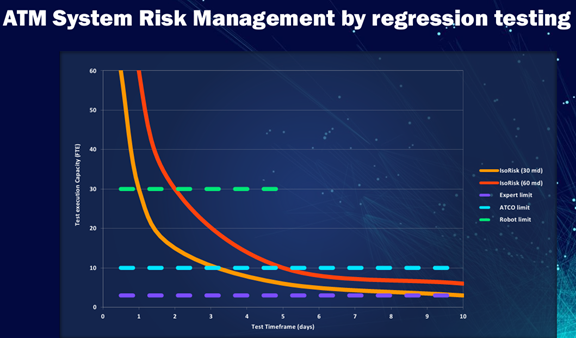
Key ROI Metrics for Leadership
- Reduced MTTR: Failures detected overnight are analyzed and classified the next working day, supporting a predictable 24-hour resolution cycle.
- Accelerated Releases: Validation cycles drop from weeks to hours, enabling faster feedback for modernization programs like the commissioning of new ATM systems.
- Sustainable Maintenance: Modern platforms separate test logic from the UI technology (e.g., Qt, Java, Web), meaning a UI change doesn’;t break your entire test suite.
Conclusion: The Path to a Manageable Ecosystem
The goal is not to replace the human expert, but to provide them with the evidence needed to sustain confidence in an increasingly complex ATM world. By establishing these foundations now, ANSPs can turn a complex ‘system-of-systems’ into a governable, measurable, and reliable reality ─ and take full control of the transition process.